Mexican
aquí
¿Es para aquí o para llevar?
Is it for here or to go?
Your answers pointed to México and Central America, or to a Latin American variety that travels well across that region. This page stands alone: you do not need the quiz to use it.
What you can check
Written s, z, and soft c are pronounced /s/. There is no /θ/ contrast of the kind taught for much of Spain.
Everyday speech uses ustedes for plural you. Vosotros forms are not the default in this variety.
ll and y merge for most speakers. You do not keep a separate palatal lateral as a listening target.
High-frequency choices include computadora, jugo, and camion for a city bus. Repair talk often uses ¿Mande?
Same meaning
Mexican
aquí
¿Es para aquí o para llevar?
Is it for here or to go?
Rioplatense
acá
¿Es para comer acá o para llevar?
Is it for here or to go?
Castilian
aquí
¿Es para tomar aquí o para llevar?
Is it for here or to go?
Where you hear it
You hear this variety across Mexico and much of Central America, and in a large share of Spanish-language media aimed at Latin America. Speaker counts for Mexico alone are on the order of 130 million; with Central America the regional reach is larger still. That size is about contact and media, not prestige.
In the app
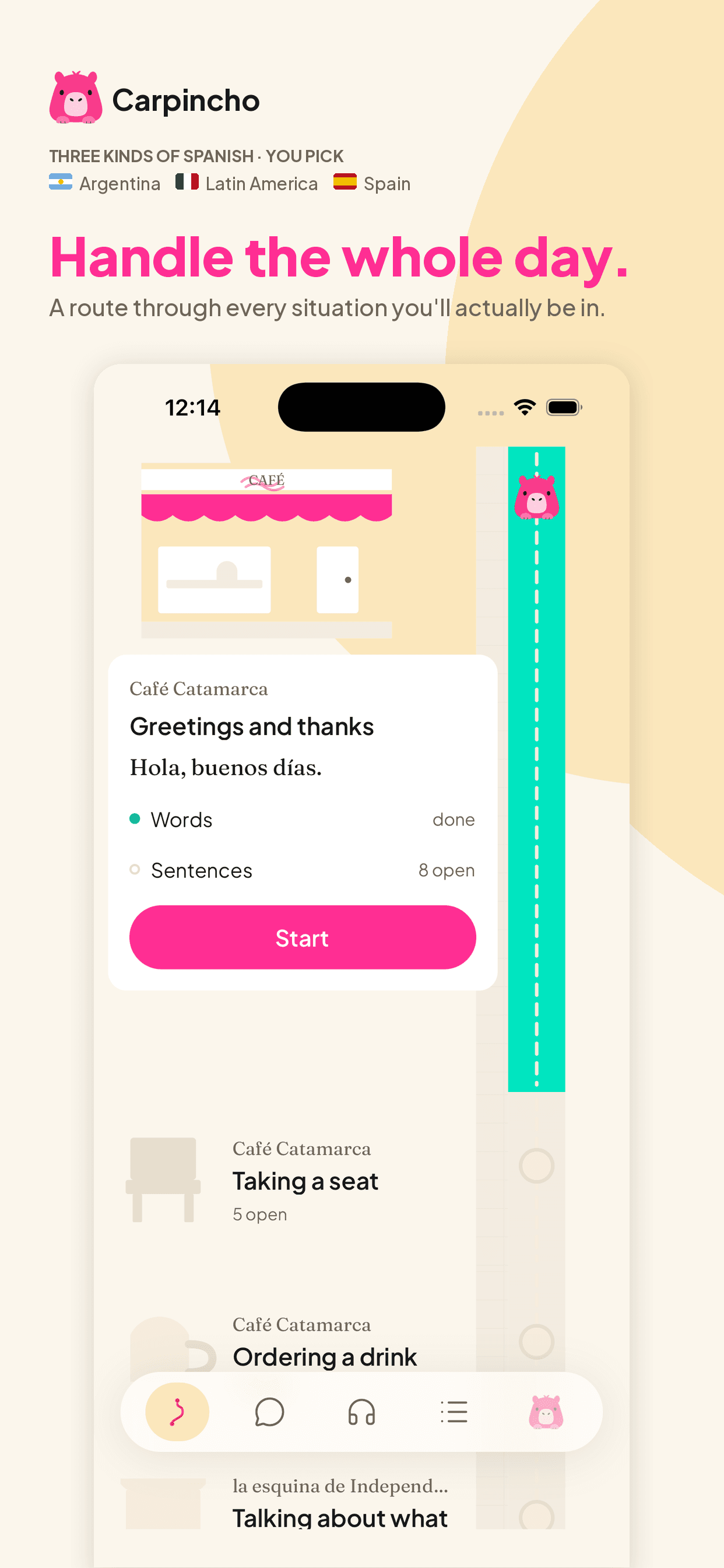
Carpincho walks you through a normal day in Spanish: a café where you greet, sit, order, ask something, and pay; then a kiosk, a market, a bus stop, a pharmacy. Every sentence is recorded in the variety you chose. When you speak, the app grades whether you would have been understood in that same variety, not against a different norm.
Compare words
On first launch, tap Neutral Latin America so the app matches this result.
← Take the quiz again