Mexican
aquí
¿Es para aquí o para llevar?
Is it for here or to go?
Your answers pointed to Spain, European media, or a sound you want that matches how Spanish is taught for Spain. This page stands alone: you do not need the quiz to use it.
What you can check
Much of Spain keeps /s/ versus /θ/ for written s against z and soft c. That contrast is a listening target in this variety.
Informal plural you uses vosotros and os in ordinary speech, alongside ustedes in formal address.
Present perfect (he comido) is common for recent past where many Latin American varieties prefer a simple past.
High-frequency choices include ordenador, zumo, coche, and vale as a routine acknowledgment.
Same meaning
Mexican
aquí
¿Es para aquí o para llevar?
Is it for here or to go?
Rioplatense
acá
¿Es para comer acá o para llevar?
Is it for here or to go?
Castilian
aquí
¿Es para tomar aquí o para llevar?
Is it for here or to go?
Where you hear it
You hear this variety across Spain in daily life and national media. Speaker counts inside Spain are on the order of 47 million. The same norms are widely taught in European classrooms; Carpincho still treats them as one variety among three equals.
In the app
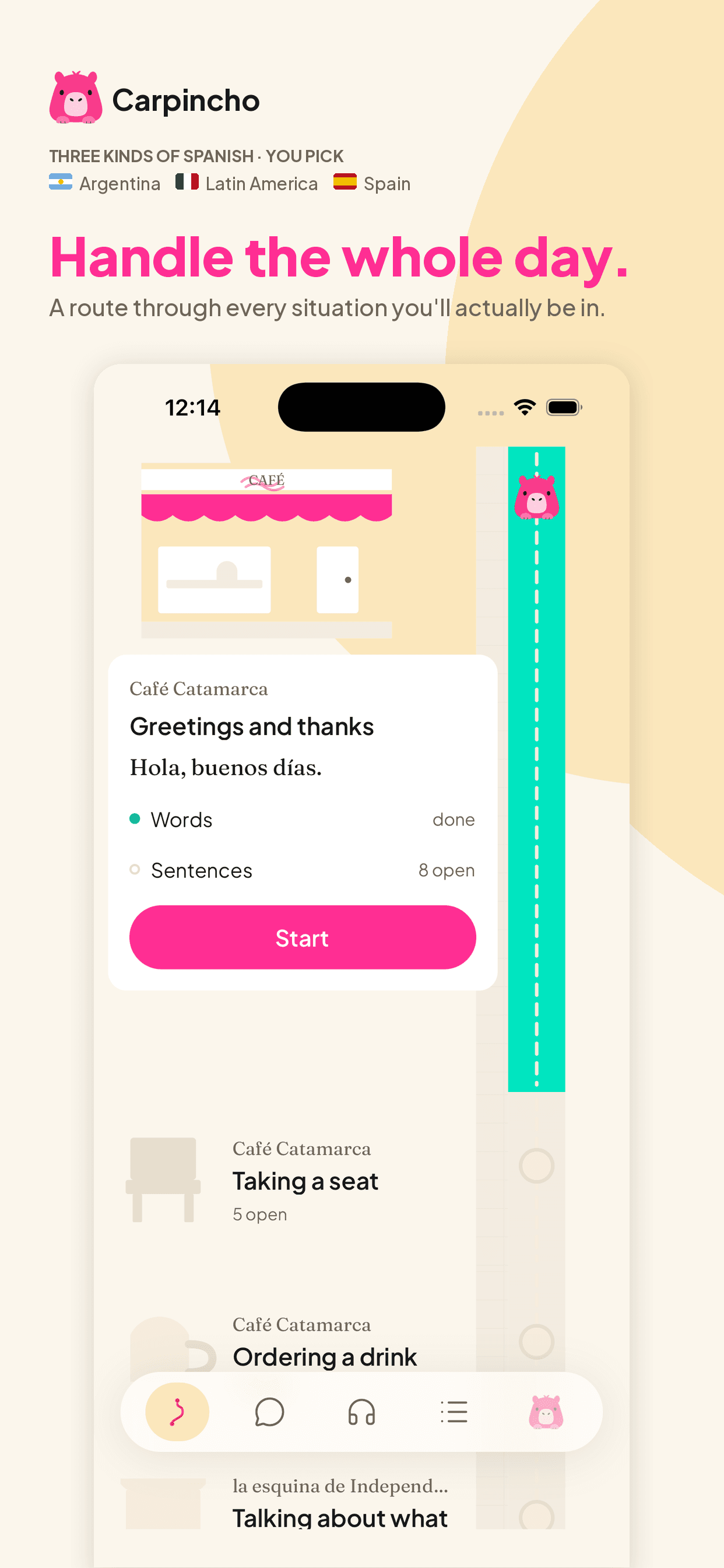
Carpincho walks you through a normal day in Spanish: a café where you greet, sit, order, ask something, and pay; then a kiosk, a market, a bus stop, a pharmacy. Every sentence is recorded in the variety you chose. When you speak, the app grades whether you would have been understood in that same variety, not against a different norm.
Compare words
On first launch, tap Spain so the app matches this result.
← Take the quiz again